PYRENEAN HORSES
The Pyrenean horse is typically the one of mountains. He is living during six
months on hebraic plateau. He gets a high agility, he is self confident, when he
is riding, he is in good health and tireless. He benefit from an independent
living, more savage than something else.
We appreciate horses from Ariege after having riding them, and his high energy
spending is striking a lot. His fame has been established in cavalerie legere
considering his way of living and moving and his ability of being obedient to
men.
Sources: "Grande Encyclopédie Illustrée d'Economie Domestique", sous la
direction de Jules TROUSSET, Paris, Anthème Fayard, sans date mais fin du XIXe
siècle, tome I, col. 1085 à 1112.
The Merens
Firstly we have to mention the Merens known through out the world.
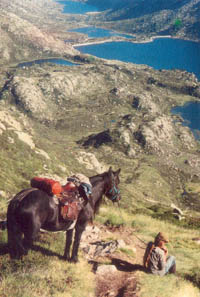
From the high valley of Ariège, this little black horse, officially listed
as a poney, is compact and robust. His qualities of rusticity is not to be
proved anymore;
In mountain, this horse has confident feet, courage and he is exceptionally
tought.
The Merens is used by professionals of mountain riding.
His little size, about 1.45 m-1.50 m safety and easier for the beginner
rider.
He is perfect for autonomous riding as well.
More than a hundred horses is being used for riding in the department of
Ariège, and this number is constantly increasing.
|
 |
http://www.haras-nationaux.fr/hn0700/telechargement/PDF_fr/fiches_races/sang_merens.pdf
top
Horse Ariègeois de Castillon.
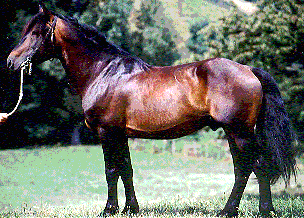
Less known than his neighbour the Mérens, the horse Ariègeois
de Castillon, which comes from the valley of Biros at the south west of the
department, has the same qualities as the Merens.
APTITUDES
As his brother, the famous horse of Mérens, the little horse
of Castillon is today perfectly adapted to leisure riding. He does not forget
his ancient military and country vocation that get him traditionally nimble,
self resistant and easy to ride.
His capacity to hold, and his ability to resist in mountains
are exceptional.
In spite of his size, he is able to work as a mule.
ORIGINE
Named as well « horse of Biros » or « St Gironnais »(from the
name of the town St Girons), the horse from Castille arose since the beginning
of the century (1908) the curiosity of a famous equestrian researcher from
Ariège : Gabriel LAMARQUE.
Highly threatened by melting blood and above all by the
progressive disappearing of his original cradle and the decreasing of the
tradition activities ( agriculture, transport…),this deserving little horse
would have been died without the work of some men in the eighties.
Historical writers say that François 1er was riding horse of
Biros during the fight of Pavie.
In 1966, the breed is officially admitted by the department of agriculture as
pure-bred.
The Ariège Pyrenean association of the horse of Castille
created in 1992 backed by National Haras of Tarbes and the Conservatory of
Biological and Regional in heritage of Midi Pyrenees organize once a year a
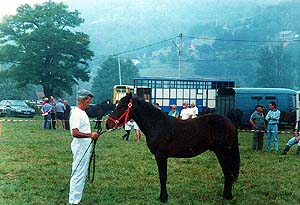
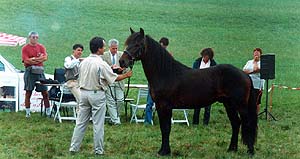
competition (in Castillon en Couserans).
Contact : APACC Mairie de Castillon- 41, rue François Camel -
09800- Castillon-en-Couserans
http://www.haras-nationaux.fr/hn0700/telechargement/PDF_fr/fiches_races/sang_castillon.pdf
top
Mule of the Pyrénées.
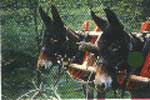
From the melting of a donkey and a mare, they belong to the
equidés. The male is sterile, the female is exceptionally fertile.
The mule of the Pyrénées , present in France as in Spain, is
rightly famous.
The mule is said to be strong as two horses, tireless, and
his living is higher than a horse.
He eats 40% less than a horse and can hold about 200 kg on steep path, that is
why he is used much of the time for the supply of high altitude mountain hut.
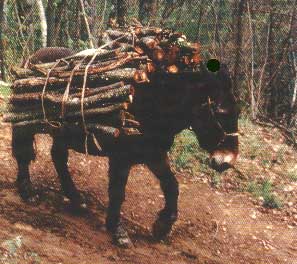
The Pyrenean mules increasingly searched for their qualities
by demanding users : militaries, forest men, biological farmers, etc…, become
expensive.
top
Donkeys of the Pyrénées.
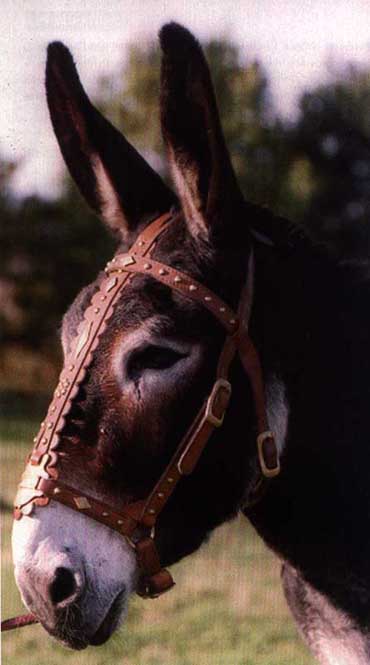 |
Works for the genetic in heritage are now done by the INRA to
protect donkeys of the Pyrénées.
These little animals, strong and courageous, will certainly play a important
role in the foreseeable development of the green tourism. |
| |
|
top